Why a Winning Product Dies After 48 Hours
By the FreeSpyAds team ·
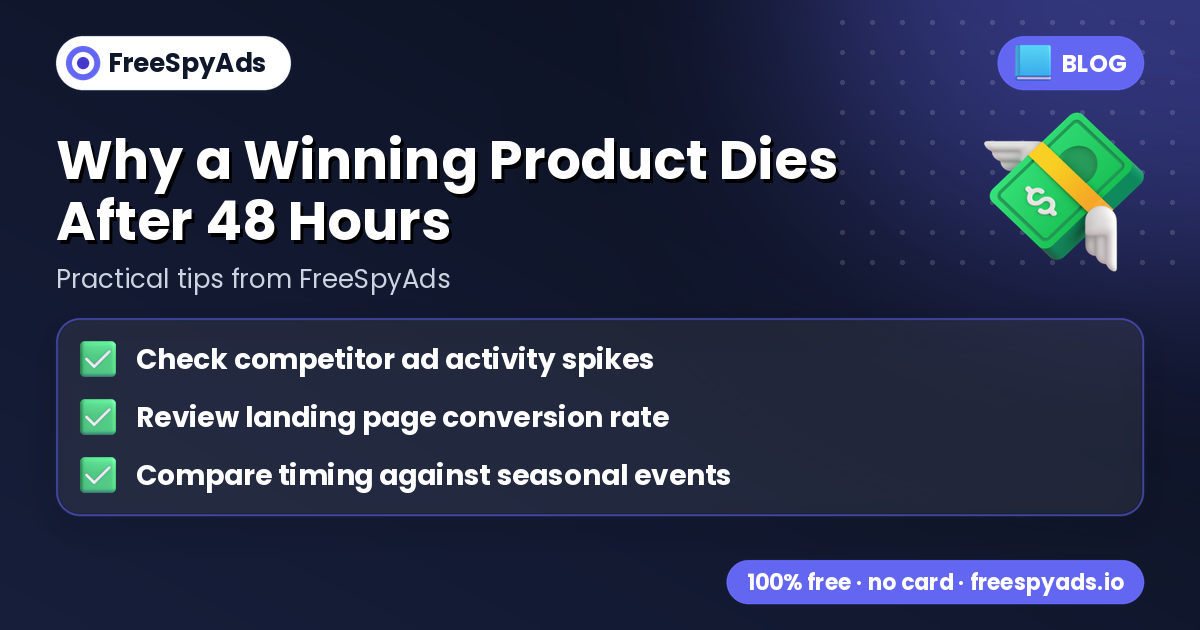
Day one looks like a winner, then sales vanish by day three with no warning. This article breaks down why that pattern happens and gives a practical checklist to figure out what actually broke, before you give up on a product too early.
The frustration is real
One seller described it exactly: strong day-one ROAS and sales, then zero sales on days two and three, even though cost per click stayed stable. CPC didn't spike, the ad didn't get shut down, nothing obviously changed, yet the sales just stopped.
That same seller said the pattern had repeated across several prior products, which makes it genuinely hard to know whether to keep testing or cut losses. That uncertainty is the real pain point: ad counts alone don't tell you whether your product died, your page broke, or competition just arrived overnight.
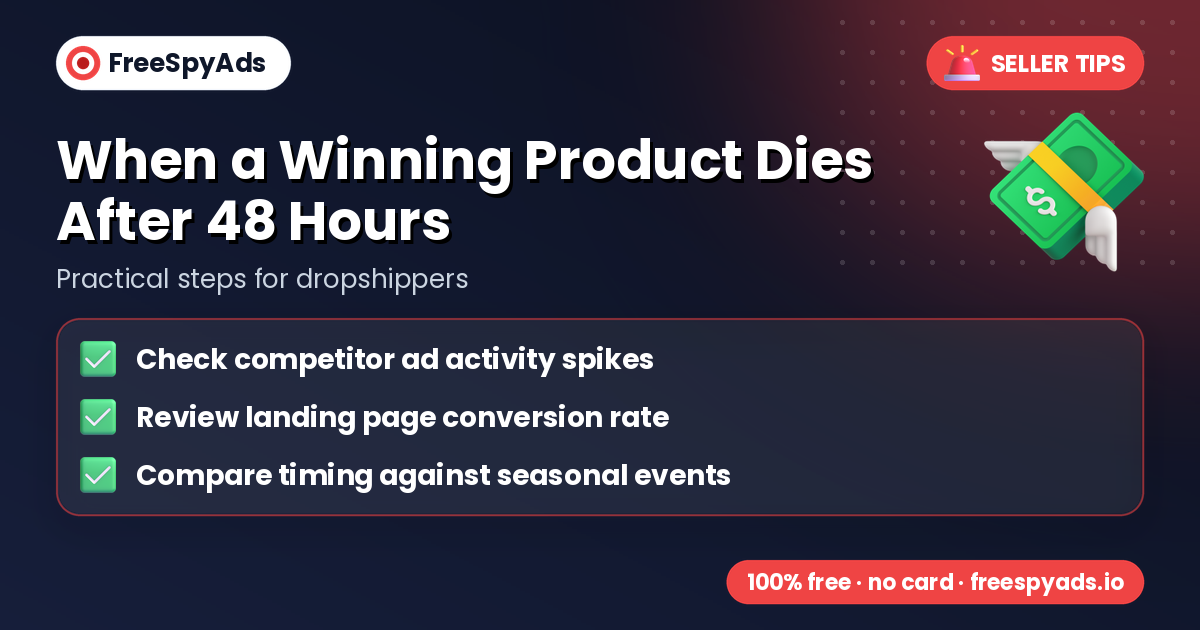
Separate three possible causes before you decide anything
Rule out rising competition first
Before you blame the product or the page, check whether other stores jumped on the same offer in the same window you saw sales drop. If a surge of new ads and new competing stores appeared right as your sales fell, you're likely looking at demand getting split across more sellers, not a dead product.
This is the core of the checklist: check competitor ad activity spikes. If several stores suddenly started running ads for the same or a near-identical product around day two or three, that timing match is a strong clue that competition, not your product, caused the drop.
Check your landing page separately from the product
Next, review landing page conversion rate on its own, apart from ad performance. A stable CPC with falling sales often points away from the ad and toward the page: broken checkout, a shipping message that changed, a review widget that stopped loading, or a price display issue that only shows up after day one traffic patterns shift.
Pull up your analytics and look specifically at add-to-cart rate and checkout completion rate for the same three-day window. If those numbers dropped sharply while traffic quality stayed the same, the page is a more likely culprit than the product itself.
Compare the timing against seasonal events
The third step is to compare timing against seasonal events. A short burst of interest followed by a flat line can simply mean you caught a small seasonal spike, a holiday-adjacent search trend, or a weekend effect that naturally fades by midweek.
If your drop lines up with a known seasonal dip rather than a competitor surge or a page issue, the product may still have a future later, it's your timing that needs adjusting, not your offer.
Where a free spy tool fits in, and where it doesn't
To actually check for competitor surges, you need visibility into ad activity, not guesses. FreeSpyAds is free with no paid plan, never asks for a credit card, and has no trial to cancel, so there's nothing to forget about. Sign up takes just a Google or email account.
It tracks stores selling the same product, new ads in the last 7 days, longest-running ad, and new stores each week, which is exactly the data you need to test the competition theory from the checklist above. You can save up to 2000 ads and export up to 10 CSV files a day with up to 500 rows each.
Be clear-eyed about its limits too: coverage is active US Facebook and Instagram ads only, no TikTok and no other countries. If your traffic or competitors sit outside that scope, you'll need to pair it with other research. See pricing for details on how it works.
FAQ
Why did my product sell well on day one but get zero sales by day three?
The most common causes are a sudden rise in competing stores and ads for the same product, a landing page issue that only shows up after initial traffic, or a short seasonal spike that naturally faded. Checking competitor ad activity, your page's conversion rate, and the timing against seasonal events separately will usually point to the real cause.
Should I keep testing a product that had one strong day then stopped selling?
That depends on what you find when you separate the three possible causes: if competitor ads surged in that window, it may just mean the market got crowded, not that the product failed, while a page problem or seasonal dip suggest different fixes before you decide to cut it.
How can I check if competitors suddenly started advertising the same product?
Look at signals like how many stores are advertising the same item, how many new ads appeared in the last 7 days, and how long the longest-running ad has been active; FreeSpyAds tracks these for active US Facebook and Instagram ads, though it doesn't cover TikTok or other countries.